
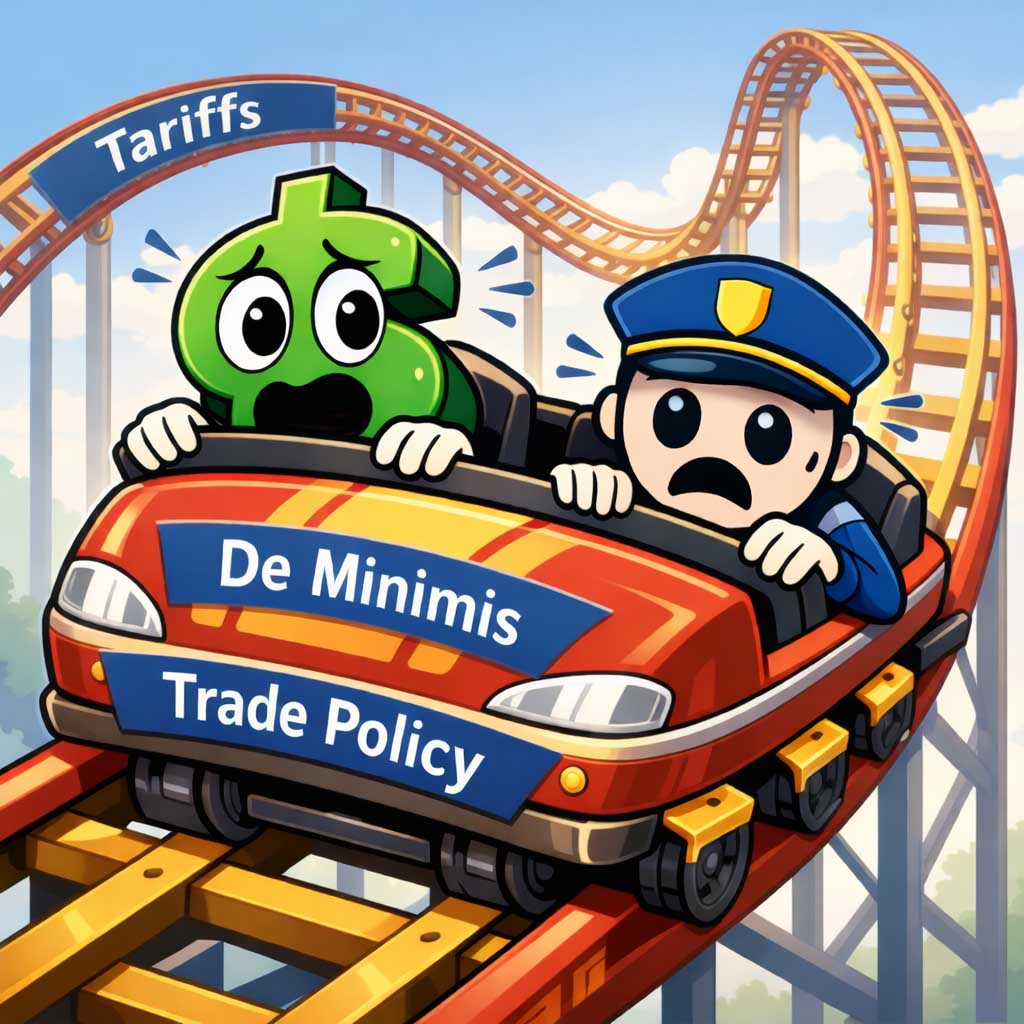
If you’ve been following our coverage of the tariff situation — from the 15% EU import duty announced in July 2025 to the collapse of the de minimis exemption last fall — you know we’ve been living through extraordinary uncertainty. The latest chapter arrived on February 20, 2026, when the U.S. Supreme Court struck down Trump’s emergency tariffs — and the president responded within hours by imposing a new global tariff under a different legal authority.
What the Supreme Court Decided
In a 6-3 ruling (Learning Resources, Inc. v. Trump), the Court held that the International Emergency Economic Powers Act (IEEPA) — a 1977 statute — does not authorize the president to impose tariffs. Chief Justice Roberts wrote the majority opinion, joined by Gorsuch and Barrett along with the three liberal justices.
The ruling invalidated the “Liberation Day” tariff structure, including the 15% on EU goods we wrote about last summer.
The court’s reasoning was direct: IEEPA has never been used to impose tariffs in its nearly 50-year history, and the law’s operative verbs involve regulating foreign actors, not raising revenue. Tariffs are a form of taxation, and Congress never clearly delegated that power through IEEPA.
The Replacement: Section 122
Within hours of the ruling, Trump announced a replacement: a 10% global tariff under Section 122 of the Trade Act of 1974, which took effect February 24. The following day he declared it would rise to 15% – announced but not yet formalized.
Section 122 is a narrower authority than IEEPA. It allows tariffs of up to 15% but only for 150 days — expiring July 24, 2026 — unless Congress votes to extend them. No president has ever invoked it before, so it is untested in the courts and almost certain to face legal challenges.
Where This Leaves euroSource
For our purposes, the picture remains cloudy:
- The July 2025 EU tariff was an IEEPA tariff, so it was struck down along with the rest. It is now replaced by the Section 122 global rate.
- The net result for EU goods is, for the moment, a 10% tariff — different legal mechanism, and a 150-day expiration clock now ticking.
- The de minimis exemption is still gone. Trump issued a separate executive order keeping it closed despite the IEEPA ruling.
- Refunds for past IEEPA tariffs are theoretically owed to importers, but the Supreme Court said nothing about how to process them.
What We Are Doing
We continue to work closely with the factory in Rudolstadt to consolidate shipments and manage costs. As we have throughout this period, we will be transparent with customers about inventory, pricing, and lead times as conditions change.
The legal landscape has never been more dynamic and difficult. One court ruling doesn’t end the story — it just opens a new chapter, and we’re watching it closely.
Leave a Reply